| Universe |
Literature / Film |
| Contents |
48 figures |
| Poses |
12 |
| Height |
24 mm |
| |
|
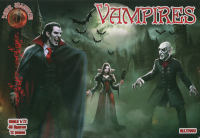
Although vampires have been a feature of folklore in many parts of the world for centuries, the modern concept of the creature was largely built in the 19th century, when several British writers took vampires as their subject, most notably the 1897 novel 'Dracula' by Bram Stoker. During these formative years many of the recognisable features were first introduced, and the first three figures in this set seem to match that image perfectly. They are all well-dressed men with a big cloak, suggesting something of the aristocratic nature of many such characters, which makes sense as they would need to be wealthy enough to maintain a spooky castle in which to reside. The poses are pretty classic too, especially the first two, so these fit with what we would expect in a set of vampires.
The last figure in the top row is of a man, more humbly dressed, who appears to be shouting. Perhaps he is a local villager, roused to vengeance by the activities of a local vampire, but perhaps he is instead a victim (or even Yoyneh Shagal from 'Dance of the Vampires')? If films have taught us anything, however, it is that vampires much prefer attractive young women as a food source, and that is what fills our second row. All these ladies are wearing full-length dresses, often cut very low at the breast, have long hair, and appear to be agitated. A couple hold a fan, and all look to be from the wealthier parts of society too, so perhaps some vampires are very class-conscious when it comes to choosing their next victim.
The first three figures in our final row look to take their inspiration from Count Orlok in the classic German film Nosferatu (1922). The facial features are clearly from this source, and again the character, a count, is well-dressed. He lacks a cloak, but is otherwise a similar character to Dracula, and is nicely done here. The very final figure is clearly meant to be the very real historical character Vlad III, ruler of Wallachia during the 15th century, more commonly known as Vlad the Impaler. While he was a remarkably cruel man, and thousands died at his hands, often in horrific ways, he was not of course a vampire, though the similarity between the fictional character name Dracula and Vlad's family name, Dracul, has forever linked this man with vampires in general.
The poses reflect the long cinematic history of portraying vampires, and as such all seem very suitable. The vampires are menacing, the victims distressed - the usual formula. What lets this set down though is the sculpting, which is really quite poor, particularly in the faces, and there is a lot of flash.
For those looking for historical figures, the one of Vlad is perfectly acceptable, and the various victims, both male and female, make good panic-stricken civilians for the 19th century, or earlier in the case of the women. This fun set delivers a lot of vampires and many associated figures, so it is a shame the sculpting is not of a higher standard.